


Alchemy on Auburn Avenue: Transforming Bricks to Stories and Back Again


It ought to be embarrassing, being enthralled by something as ordinary as a brick. Several days after attending Table of Contents, a fascinating discussion between two local Atlanta writers, I caught myself studying a well-worn path out the window during church.
It was a stretch of red clay rectangles, a shortcut crossing diagonally across a century-old courtyard. The standard four-inch blocks were turned sideways, forming triplets of holes in an ochre polka-dot grid, the tufts of grass poking through the voids glowing in the morning sun.
How many times had I strolled past without wondering who’d laid the bricks in place? Which Georgia hillside had been mined for the clay? Had the laborers been paid fairly for their efforts? Was their orientation intentional, offering easier passage for rainwater to soak into the ground?
I blinked, caught the reflection in the dusty windowpane, then smiled.
This was a familiar, often lonely loop I found myself in: bewitched by a particular object or situation or person, puzzling over how to bring the spirit of a story to life. But ever since the event, held at Constellations in the Sweet Auburn neighborhood, bricks in particular have been on my mind.
Like many cities across the South, bricks are the foundation of Atlanta’s built environment. Dressing townhomes, courthouses and restaurants, lining streets, walls and pool decks, formed of clay, sand and water, fired at intense heat. From the forced labor of incarcerated men at the Chattahoochee Brick Company, to the perimeter walls of Oakland Cemetery, the city is filled with brick-bound stories.
Atlanta as setting and inspiration featured heavily in the dialogue between Hannah Palmer and Jamie Allen, accomplished writers and friends whose place-based and thoughtful work is deeply rooted in observation and discovery. Geared toward authors and readers of any genre, the conversation ranged from origins and struggles to best practices and successes. As an unexpected gift, they were even presented with a personalized brick recognizing their literary contributions.
More than just a book promotion event, this gathering highlighted the reciprocal relationship between the everyday places that mold us and the extraordinary stories we craft from them. In turn, these narratives, when shared collaboratively, possess the power to reshape our surroundings and foster a supportive community.

I first saw the event advertised on Hannah Palmer’s Instagram. I’ve followed her work for years, a mixture of environmental advocacy, engaging local history and relatable memoir. Her style of storytelling is epitomized in her latest book, The Pool is Closed, a travel diary documenting her visits to swimming locations across Atlanta as she explores the ongoing effects of racial and socioeconomic segregation.
The event introduced me to Jamie Allen and his new novel, The Dashing Diner, which features a wily thief targeting chic Atlanta restaurants, though it primarily focuses on the colorful employees and clientele at a start-up French eatery.
For over a week I debated attending, ultimately registering on the last day. Like a newcomer to any space, I was nervous about showing up: still trying to find my niche as an author with an engineering day-job, dabbling between genres and styles, yet drawn to the interconnectedness of human relationships, the built environment, and the natural world.
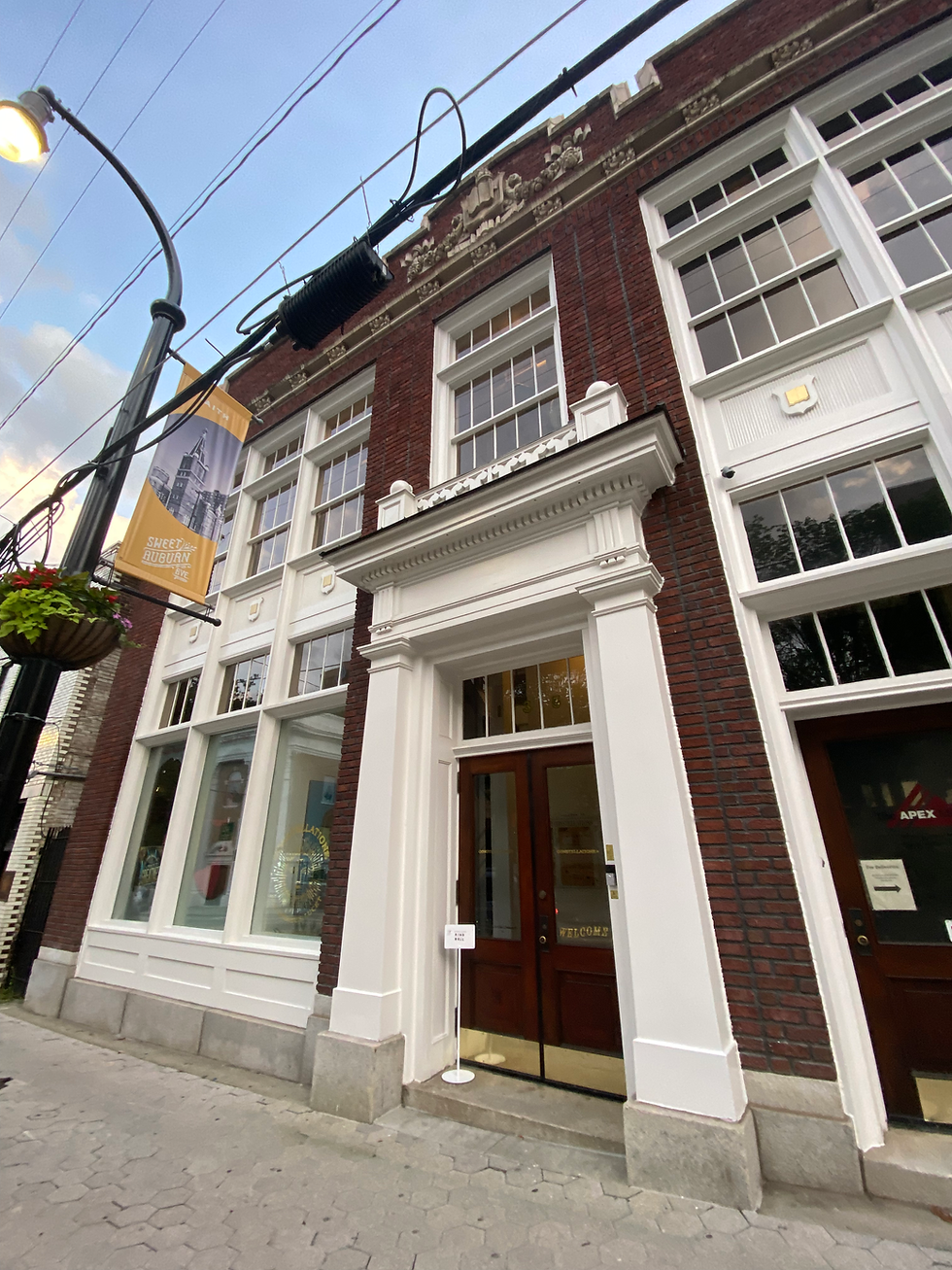
The muggy evening air was almost stifling as I left the office and took the train downtown. Walking a few blocks south then east, I followed the outskirts of Georgia State’s campus, past the curved facade of the Auburn Avenue Research Library to the well-preserved Southern Story Book Building.
Up on the second floor, I found a spacious loft filled with natural light, chic furniture, and a lively group of people milling around a white granite bar. I slipped away to the bathroom to delay talking to strangers, but when I reemerged, I was immediately greeted by a grinning man with slicked hair, round glasses and a well-groomed, gray beard. This was Jamie. As he pointed me to the sparkling water, I took a deep breath and relaxed.
With a drink in hand, I talked with a woman also standing near the edge of the room. She smoothed her hair and politely answered my questions. I was surprised to discover we both enjoyed practicing yoga and walking trails along Peachtree Creek.
As the gathering grew to about two dozen people, Hannah ushered us into a study furnished with blue suede couches and a wall-length bookshelf. In her green slacks and striped button down, Hannah looked ready to both give a lecture and hike in the woods, which matched her reputation. She shook my hand and asked for my name, remembering that we’d recently met at another author’s book launch event.
I wonder now if I blushed, slightly star-struck. But the next minute she was introducing herself to another guest, then laughing with another. This felt different than other writing groups I’d participated in before, like being invited into a job interview, class, and family reunion, all at the same time.
The sunset flooded across the brick walls and wood floors as we settled into the study, light glinting off the clear tables adorned with antique store knick-knacks. Hannah and Jamie sat with their backs to the bookshelf, side by side in rounded-back arm chairs, facing their audience. I made small talk with the couple sitting on the couch nearby. They lived less than a mile away from me, in a similar brick house with granite foundation, common throughout the hilly subdivisions that took over swaths of farmland after World War II.
Gene Kansas, the event host, addressed the room from the doorway, gesturing warmly as he gave an overview of the building’s incredible history. In the 1960s it was the headquarters of the Student Nonviolent Coordinating Committee (SNCC), witnessing the likes of John Lewis, Septima Clark and Bayard Rustin as they led a generation toward a more perfect union. Kansas, a real estate developer and preservationist who wrote Civil Sights, an account of Sweet Auburn’s history, alluded to his own culturally-rich childhood in New Orleans, surrounded by artists, judges and working class families. He gestured, perhaps toward the authors, the bookshelf, or to the building he’d helped preserve, claiming “who we are as kids is who we are as adults.”
After introducing Hannah and Jamie, Gene stooped and lifted a loose terracotta brick, running his fingers over an inscription. He dipped his head toward the speakers, thanking them for their commitment to their craft, for investing in works that portrayed and uplifted their community.
A Posse ad Esse, he read from the brick, before bestowing one to Hannah and then another to Jamie. Both were wide-eyed with gratitude as Gene sat down.
From being able to being. From potential to actual.

“This will be the second brick on my desk.” Hannah leaned forward, as if the memento densified as she studied it. She’d recovered a brick from the site of her childhood home, she told us, while conducting research around the Atlanta airport for her first book, Flight Path.
As the sun disappeared behind the skyline, she asked Jamie where his stories come from. He stretched his legs, sharing how he came from a family full of storytellers. His focus on baseball during school obscured his talent for communication, until he began receiving good feedback on his writing assignments. Eventually, his experience in journalism and copywriting connected him with the power of compelling narrative. He gestured to a map hanging on the wall, his “Squirrel Census” of New York’s Central Park, a prime example of his drive to take projects seriously, even when the premise may seem absurd.
Hannah identified Jamie’s attitude as the reason she asked for his help on a project of her own: the Atlanta Creek League. Designed as a way for neighborhood networks to be formed around watersheds rather than street grids, Hannah and Jamie collaborated on a website and competitive stewardship model styled after recreational sports leagues. Not surprisingly, the wellspring for Hannah’s storytelling was playing in creeks and ponds as a kid, as well as sitting through long sermons delivered by several pastors in her family. These are still the bedrock of Hannah’s witty and insightful essays, incorporating personal anecdotes with a strong sense of responsibility and clear-eyed truth-telling.
Both recounted their circuitous path to make a living as a writer, through journalism, freelance work and marketing, from New York to LA and back to Atlanta. What seemed to sustain them were authentic friendships in which they could share their ambitions and rejections, their anxieties and epiphanies.
For Jamie, writing a novel was an intimidating feat. He wrote screenplays, essays and countless magazine articles, but suffered rejection after rejection with the first novel he wrote. One day he convinced himself he was writing “an entertainment,” which mitigated his fear of “screwing up.” He began caring more deeply about the emerging set of characters, who eventually populated The Dashing Diner. He committed to early mornings of steady writing, not slowing to edit or nitpick, powering through to a first draft. It wasn’t until after he had a complete manuscript that his son and friend convinced him to recognize the project for what it was: a novel.
Hannah faced a similar bout of mental gymnastics, trying to transition from gathering research and interviews to establishing a rhythm of narrative development. However, the goal of The Pool is Closed crystalized early. While teaching her kids to swim several summers ago, they were invited to a secret neighborhood pool, sheltered between an interstate barrier and a tire-filled creek. Their afternoon at the all-white, exclusive, midcentury watering hole opened Hannah’s eyes to ongoing patterns of social segregation and inequity. She made a prescient post on social media about the accessibility of local pools, claiming it as the subject of her next book.
Seeking to ground her writing with personal accounts, she asked nearly everyone she met at pools around town how they learned to swim, from life guards to sun bathers. She blocked out weekends away from home to make progress on the book. After improving several drafts, she had a breakthrough when an essay about one of her local adventures was picked up by The Bitter Southerner.
Jamie ultimately decided to publish his novel independently, giving him creative control over marketing and distribution. At first he seemed a bit sheepish about this accomplishment, but when he read a passage aloud, featuring a personable waiter and hapless cook, it sounded like he was recounting a conversation with his close friends. There were murmurs of appreciation when he shared the book’s unofficial tagline: “a story of building your own family out of broken pieces.”

When Hannah read an excerpt of her book, I noticed how Jamie stroked his beard often, nodding. Her experience at Piedmont Park’s bustling pool touched profoundly on a range of topics: the taste of an ice pop beneath the summer sun, anxiety over her sons’ safety, voyeurism in public bathing venues, the history of Lake Clara Meer.
Hearing both of the authors read portions of their writing highlighted their skilled observation, but also seemed like an invitation to us as the audience. To notice what captures our attention and then to carry that line of questioning authentically and dutifully into creation. With any luck the “entertainment” may one day become a memoir, a novel—a familiar form, like a brick—made new by our unique voice, repurposed from the clay of our inspirations.
I wondered, staring at the pock-marked walls, about the possibility of more spaces like Table of Contents: collaborative niches of hybrid-profession storytellers throughout Atlanta and beyond, hubs of thoughtful innovation, shining light on stories that are transformational yet grounded, like a building steeped in history repurposed strategically for the future.
Afterward we were invited to ask questions, and the thrum of curiosity expanded the conversation around the room for another half hour. On my way out, I bought Jamie’s book and told Hannah I was enjoying reading hers. Down at the sidewalk, I took note of the granite scroll and book cast into the parapet of the rust-red facade. On my walk south to the train station, each brick, doorway and face I passed was a story in itself.


Comments