


Words of Welcome: Learning To Read in an Old-Growth Forest


Her voice was unhurried and reassuring, each line of poetry settling gracefully over the unfamiliar room like a benediction. Seated with half a dozen strangers on a Friday evening in southwest Atlanta, I listened as the writing instructor gave thoughtful attention to mundane objects in the classroom: the rustic wood of the slanted ceiling; the cold gray floors beneath our feet; the metal chairs holding our bodies; a stack of folding tables resting against a wall.
My shoulders relaxed, the anxiety of being a newcomer melting away. I showed up knowing little about the writing workshop other than its title, “Reading Nature.” To my surprise, we revisited the basic process of learning how to read, then applied this crucial skill to our immediate surroundings: an unassuming classroom overlooking an old-growth forest. Ultimately, I felt deeply welcomed into the room, swept into the story of a unique and celebrated community center.
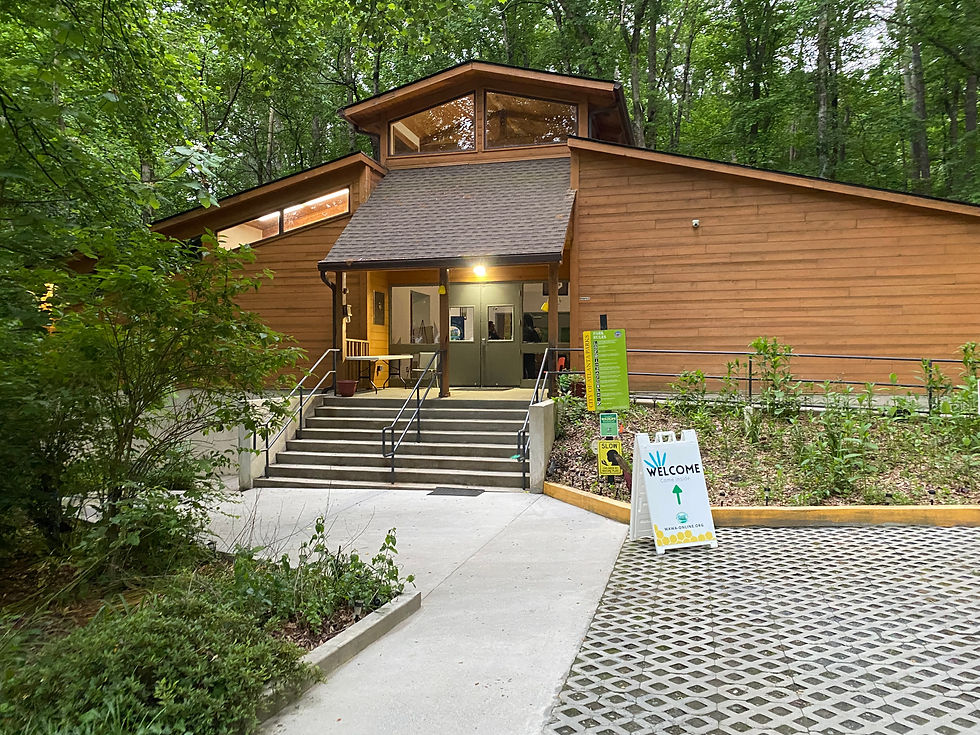
An hour earlier, I had emerged from my car with a journal under my arm and a flagging spirit. The towering pine trees around the small parking lot seemed to stretch into a vaulted ceiling, cocooning the remnants of my stressful workday and dwarfing the rustic, wood-framed Outdoor Activity Center (OAC).
Disappointed to move inside, I ascended the concrete steps and entered a dimly-lit lobby extending the depth of the building, the woods still visible through the far windows. The quiet space was equal parts log cabin and living room, with wooden rafters, puffy couches and a colorful display documenting the work of the West Atlanta Watershed Alliance (WAWA), a nonprofit dedicated to improving the health of local waterways and people in predominantly Black neighborhoods. For years I’d heard about this facility, a City park managed by WAWA. As a white engineer from across town, this writing workshop may not have been geared toward me, but still I was eager to glean wisdom from a group invested in a particular place, willing to prioritize creative expression even while tackling injustices.
A woman at the reception desk directed me into the classroom. Beyond the threshold was a clash of styles: two slate gray walls, two paneled like a wilderness lodge; a small table with a plexiglass dome reflecting the harsh fluorescent lighting; tall, tinted windows. The attendance was modest: six people sat at white tables facing a large-screen TV. A kind-eyed woman in the center introduced herself as Eder Williams McKnight. Her braided hair was pulled into a bun, and large earrings framed her smiling face. She gestured to a water cooler and snacks, including a dish of mulberries collected from her yard. I settled into a chair with a handful of deep-purple fruit, opening my journal to a new page. Nearby, a couple women chatted like old friends. A young man in a hoodie and glasses munched on chips.
Ms. McKnight welcomed us with a gentle voice, sharing her background as an educator and poet. Surprisingly, I was the only first-time visitor, and almost everyone else was a teacher. I felt a pang of embarrassment for misunderstanding the event’s focus. But the purple stains on my fingers were a sign that I, too, was welcome here.
McKnight’s recent transition to Atlanta had been eased by walks in the nearby Cascade Springs Nature Preserve, where she could slow down and write poetry. This I could relate to: seeking refuge and inspiration in nature, amidst the hubbub of a sprawling city. A WAWA employee in a knit cap and overalls explained how we were in the Chattahoochee River watershed, ancestral land of the Muscogee people forced westward. The surrounding Bush Mountain community, she continued, was established by emancipated African Americans after the Civil War. The OAC facility was built half a century ago; but just outside the windows, a “Grandfather Beech” tree was estimated to be more than a hundred years older.

McKnight gestured energetically as she paced the room. She encouraged us to listen carefully to each person’s perspective, noting how the experience of being genuinely heard as an adult is akin to a baby being swaddled. We considered what happens when we read: the transportative tunnel vision we slip into, interpreting arcs and lines, getting lost in a narrative. How intimidating and exhilarating this experience can be, learning to trust our teachers and ourselves until a light of recognition dawns. I thought of the field behind the yellow house where, as a child, I sat next to my mom as she led me through the alphabet. I remembered the illustrated worm poking out of a red apple.
We spent time observing the room from our seats, using the raw materials gathered with our senses to write a list poem. She encouraged us to move past snap assessments so we could instead “form a relationship” with the space. When we shared our work, there was some overlap between writers, but each person also had their attention drawn to different sights, smells or sounds.
This is the Room . . .
by Joseph R. Goodall
This is the room that used to be one open space,
where flickering fluorescents mask the forest
beyond the windows of multi-use, one-size-fits-most-events.
Where mulberry stained fingers make list poems with a blue pen,
where an old table top diorama provides
a miniature birds-eye view beneath a bubble of plexiglass.
Where an eerie hum distracts many a visitor,
where cedar (or is it pine?) forms the ceiling overhead.
Later, we wandered the room and wrote about what it communicated to us. I was drawn to the dome in the corner, which contained a topographic model of the forested hill surrounding the OAC. Its colors and scale spoke a familiar visual language, reminding me of the Seminole village diorama I saw as a child at a natural history museum. During our group debrief, it struck me how engaging a variety of artistic mediums and storytellers can help us recognize and confront stereotypes, zoom out and get a wider picture, or uncover underlying truths.

As the sun was setting, we filtered out the back door for another activity of reading and response. We spread out among the gray, textured tree trunks rising from the rolling forest floor. McKnight encouraged us to quietly build a relationship in this more expansive, organic environment, and then to make note of what questions came to mind.
In the dimming light, I noticed the hexagon concrete pavers at the bottom of the wooden stairs, then the clusters of colorful bird boxes propped up on metal poles at forehead height. A sign at the base of the posts warned against playing near the boxes. I didn’t see any bird movement. Instead, stationary patterns were etched into the landscape: log-lined trails winding over the hills, a chain link fence encircling the shaded grove, a locked gate advertising open hours. I heard the trill of a carolina wren beyond the fence, then a woodthrush, identified by an app on my phone. Around the corner of the building stood fragrant, wooden containers filled with compost, along with information displays about the decomposition process.
I grew overwhelmed by the rush of observation and inquiry. What was there, what wasn't. The birdhouses and signs and old trees and fences. The paths carved through the space, the residue left behind by humans, plants and a million other creatures, much of it beyond the range of my senses. For several minutes, I rested on a sagging picnic table and took notes in my journal.
Back inside the classroom, we took turns sharing our notes, considering how a forest, like a room, can hold many interpretations, from sweat to tranquility to violence. When I read with hesitancy from my pages, the teacher reassured me that my disparate, philosophical musings wern't a hurdle to surmount or to solve. They themselves can be the message, an invitation to keep looking: in with observation, out with creativity. Through the gift of reading and the warmth of carefully-stewarded sites like the Outdoor Activity Center, the sting of exclusion and fear can be dispelled by refreshing communion.
Finally, we listened to McKnight share her writing, closing our eyes to “see” as she saw. Every fluorescent flicker, leaf flutter and squeak of a shoe was food for our imagination. Outside, the trees swayed with applause. I sensed we were all grateful for this moment to rest and absorb.
How blessed are the unexpected places where we are ushered in with welcome, even while still strangers. Where we can relax into the home of our bodies, reintegrated physically and physchologically. Where everything slows down and we can begin to truly see the world around us, to know even as we become known.
A Meditation at WAWA Outdoor Activity Center
by Eder J. Williams McKnight
This is beauty to sit
put weight on this play structure
its worn wood
one day it will erode into dirt
This is beauty all the pine needles
and fallen leaves crushed
their odors rise like exhalations
the tiniest green insect finds me
I get to be still among the call
of birds beneath airplanes
who learned to fly
from them
I get to watch light halo trees
learn what it means to grow tall
root deep
find ways to be quenched by water
one day the roots will make new soil
one day progeny
many generations from now
will find me


A great read and adventure Joey